
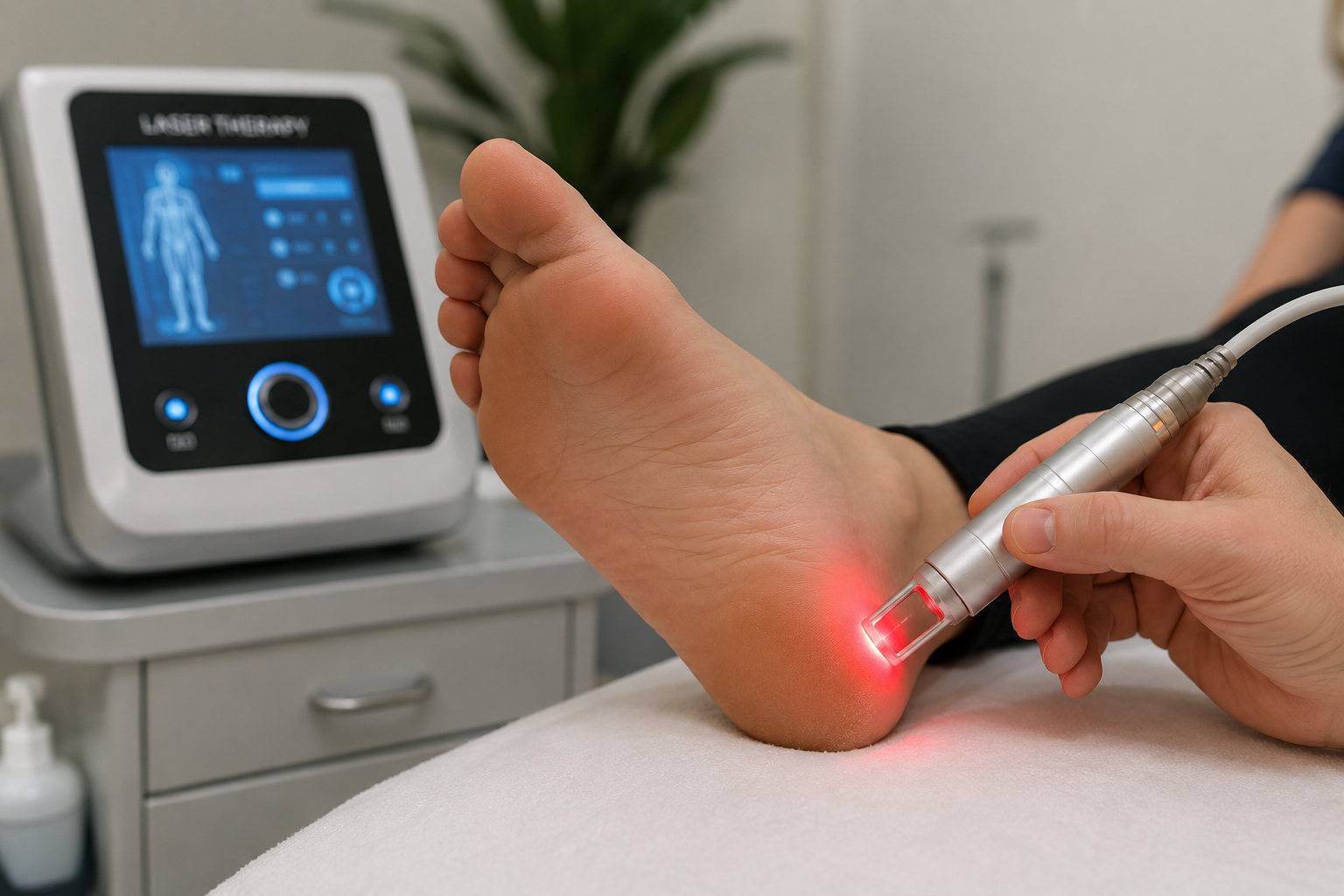
Remy Class IV Laser Therapy in NYC
Advanced Class IV laser therapy for pain management, tissue healing, fungal toenails, plantar warts, peripheral neuropathy, and a broad range of foot and ankle conditions – non-invasive, painless, and requiring no downtime.
Walk NYC Podiatry utilizes the Remy Class IV Laser – a state-of-the-art dual-wavelength therapeutic laser delivering optimized laser energy at 810nm and 980nm. The Remy is one of the most clinically versatile and technologically advanced Class IV lasers available in podiatric medicine today – offering a range of therapeutic applications that address both the symptoms and the underlying biological drivers of foot and ankle conditions.
What Is Class IV Laser Therapy?
Class IV laser therapy – clinically known as photobiomodulation (PBM) – uses concentrated near-infrared light energy to penetrate deep into biological tissue, stimulating cellular repair and recovery at the mitochondrial level.
When laser light contacts the skin, photons penetrate underlying tissue and are absorbed by the cells. This triggers an increase in the production of ATP – adenosine triphosphate – the primary energy currency of the cell. Increased ATP production accelerates cellular metabolism, stimulates collagen synthesis, enhances local circulation, and activates the body’s natural immune and repair responses.
The result is a clinically meaningful reduction in pain and inflammation, accelerated tissue healing, improved circulation, and – in specific applications – targeted disruption of fungal and viral organisms without harm to surrounding healthy tissue.
Class IV lasers deliver significantly higher therapeutic energy than Class III cold lasers – allowing for deeper tissue penetration and more clinically meaningful biological effects. The Remy operates at up to 30 watts of peak power, ensuring therapeutic energy reaches the structures that need it most.
Biological Effects of Remy Class IV Laser Therapy
- Reduce Pain & Inflammation: Laser energy decreases inflammatory mediators, improves lymphatic drainage, and modulates nerve conduction to meaningfully reduce pain signals – without medication and without side effects.
- Accelerate Tissue Healing: Stimulation of mitochondrial ATP production increases cellular metabolism, collagen synthesis, and tissue repair – accelerating recovery from injury, tendinopathy, and chronic soft tissue conditions.
- Enhance Circulation: Therapeutic laser energy promotes vasodilation, improving local blood flow and delivering increased oxygen, nutrients, and cellular repair factors to the treatment site.
- Trigger Immune Response: Laser light stimulates immune cell activity and local immune signaling – directly relevant to the treatment of onychomycosis and plantar warts, where the immune response plays a central role in clearance of the causative organism.
Clinical Applications at Walk NYC Podiatry
Pain Management & Musculoskeletal Conditions
Remy Class IV laser therapy is used at Walk NYC Podiatry as an integral component of the treatment plan for a wide range of painful foot and ankle conditions. By reducing inflammation, stimulating tissue repair, and modulating pain signals at the cellular level, laser therapy provides meaningful relief for conditions that have often not responded adequately to conventional treatment alone.
Conditions where laser therapy may be beneficial include:
- Plantar fasciitis and heel pain
- Achilles tendinopathy
- Posterior tibial tendon dysfunction
- Peroneal tendon injuries
- Metatarsalgia and ball of foot pain
- Neuroma
- Capsulitis
- Arthritis of the foot and ankle
- Ankle sprains and ligament injuries
- Chronic overuse and soft tissue injuries
- Post-procedure tissue recovery and wound healing support
Fungal Toenails – Onychomycosis
The Remy laser is FDA-cleared for the temporary increase of clear nail in patients with onychomycosis – including dermatophytes Trichophyton rubrum and T. mentagrophytes, and yeasts including Candida albicans.
Laser energy is delivered through the nail plate to the nail bed, where fungal organisms reside. The thermal and photobiological effects of the laser disrupt fungal cell structures without harming surrounding healthy tissue – making it a particularly valuable treatment option for patients who prefer to avoid or are not candidates for oral antifungal medication.
At Walk NYC Podiatry, laser therapy for fungal toenails is integrated into a comprehensive treatment protocol that also addresses contributing mechanical, environmental, and hygiene factors – because treating the infection alone without addressing what sustains it rarely produces lasting results.
Plantar Warts
The Remy laser at 980nm is FDA-cleared for the ablation, vaporization, incision, excision, and coagulation of soft tissue – including periungual, subungual, and plantar warts.
Laser therapy targets the blood supply feeding the wart, disrupting the vascular network that sustains the viral growth – without cutting, without open wounds, and with minimal downtime. It is particularly effective for warts that have not responded to conventional over-the-counter treatments and for patients seeking a non-surgical approach.
Wart laser therapy is frequently covered by insurance – patients are advised to confirm coverage with their individual plan.
Peripheral Neuropathy
Peripheral neuropathy – reduced sensory and motor nerve function in the feet and lower legs – is among the most challenging conditions in foot and ankle medicine, with significant implications for pain, balance, fall risk, and quality of life. Laser therapy supports nerve function and tissue health by improving local circulation, reducing inflammation, and stimulating cellular repair in the affected tissues – making it a valuable adjunct in the comprehensive management of peripheral neuropathy.
Athlete’s Foot & Skin Infections
The immune-stimulating and antimicrobial properties of Class IV laser therapy make it a useful adjunct in the treatment of persistent fungal skin infections including tinea pedis – particularly in cases that have not responded adequately to topical therapy alone.
Wound Healing Support
Laser therapy’s ability to accelerate cellular repair, improve circulation, and reduce inflammation makes it a valuable addition to wound care protocols – supporting healing in chronic wounds, post-procedure recovery, and diabetic foot conditions where tissue healing is compromised.
What to Expect During Treatment
Remy Class IV laser therapy is a comfortable, non-invasive in-office procedure. Patients typically experience a gentle warming sensation at the treatment site – there is no pain, no needles, and no recovery time required. Treatment sessions typically last between 5 and 15 minutes depending on the condition and the area being treated.
The number of sessions required varies by condition and severity. Some patients experience meaningful relief after a small number of sessions. Chronic conditions – particularly fungal toenails and peripheral neuropathy – typically benefit from a series of treatments as part of a longer-term management protocol. A realistic treatment timeline is discussed at the initial consultation.
Remy Class IV Laser – Technical Specifications
- Wavelengths: 810nm and 980nm dual-wave
- Peak Power: 25 watts
- Operation Modes: Continuous wave and repeat pulse
- Display: 7-inch true-color touch screen
- FDA Clearance: Pain relief, onychomycosis, and soft tissue applications including warts
Insurance & Payment
Laser therapy for plantar warts is frequently covered by insurance. Laser therapy for fungal toenails, pain management, peripheral neuropathy, and other applications is generally not covered by insurance and is offered as a self-pay service. Pricing varies depending on the condition and number of sessions required and is discussed transparently at the initial consultation. Financing options are available for patients seeking to spread the cost of a treatment series over time.
Frequently Asked Questions
What is the difference between Class IV laser therapy and cold laser therapy?
Class III cold lasers operate at very low power levels – typically under 500 milliwatts – and have limited depth of tissue penetration. Class IV lasers like the Remy operate at significantly higher power levels, delivering therapeutic energy deep enough to reach tendons, ligaments, joints, and nail structures. The clinical difference in tissue penetration and therapeutic effect is substantial.
Is laser therapy painful?
No. Remy Class IV laser therapy is a painless procedure. Most patients experience a gentle warming sensation at the treatment site. There is no discomfort, no needles, no cutting, and no recovery time required.
How many treatments are needed?
This varies significantly depending on the condition being treated and its severity. Acute pain conditions may respond after a small number of sessions. Chronic conditions – including fungal toenails, peripheral neuropathy, and longstanding tendinopathy – typically require a series of treatments over several weeks. A personalized treatment plan is discussed at the first visit.
Is laser therapy covered by insurance?
Coverage depends on the specific condition being treated and the patient’s individual insurance plan. Laser therapy for plantar warts is frequently covered by insurance. Laser therapy for fungal toenails and pain management is generally not covered and is offered as a self-pay service. Patients are advised to check with their insurance provider for specific coverage details.
Can laser therapy be combined with other treatments?
Yes – and it is most effective when used as part of a comprehensive treatment plan rather than as a standalone therapy. At Walk NYC Podiatry, laser therapy is routinely integrated with orthotic therapy, biomechanical correction, regenerative medicine, stretching and strengthening protocols, and footwear modification – addressing the condition comprehensively rather than in isolation.
How soon can I expect results?
Many patients notice improvement in pain and inflammation after the first few sessions. For fungal toenails, visible improvement requires time – toenails grow slowly and meaningful nail clearance typically takes several months as healthier nail gradually replaces the damaged nail. For peripheral neuropathy, improvement in sensation and comfort is gradual and varies by patient. A realistic assessment of expected outcomes is provided at the initial consultation.
Are there any conditions where laser therapy should not be used?
Laser therapy is contraindicated over malignant lesions, directly over the eyes, over the thyroid gland, and in patients with active cancer at the treatment site. Patients who are pregnant should consult with their physician before undergoing laser therapy. A thorough health history is taken before treatment to ensure laser therapy is appropriate for each individual patient.