
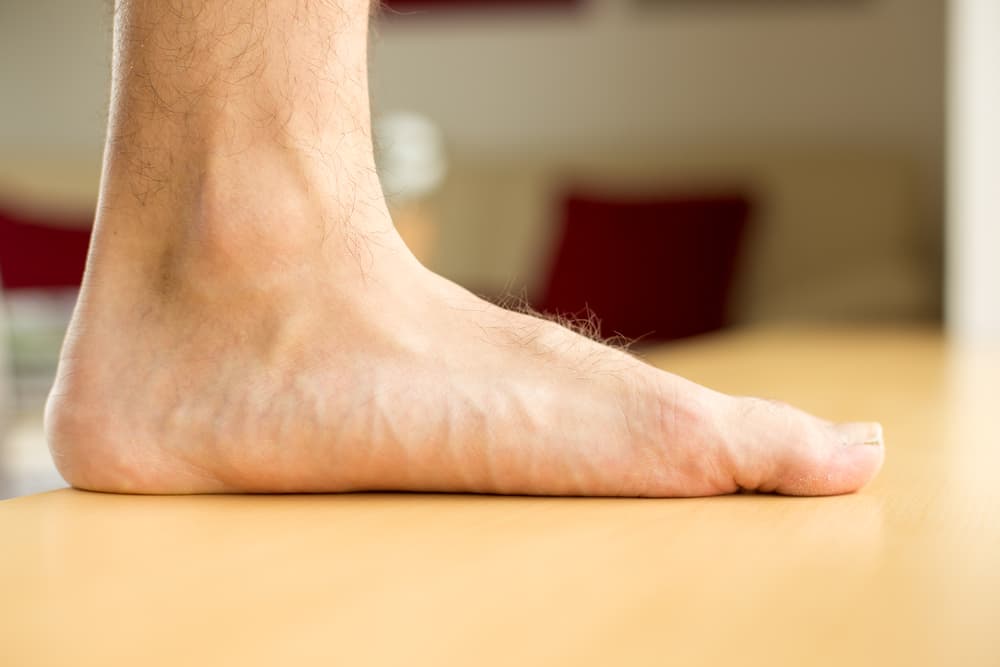
Flat Feet & Alignment Disorders at Walk NYC Podiatry
Comprehensive evaluation and treatment of flat feet, alignment disorders, and the far-reaching effects of poor foot mechanics on the knees, hips, posture, and lower back.
The feet are the foundation of the entire body. Like any structure in nature, when the foundation is poorly aligned, unstable, or mechanically compromised, everything built upon it is affected. This is not a perspective – it is physics. And yet the relationship between foot alignment and chronic pain in the knees, hips, and lower back remains one of the most consistently overlooked connections in mainstream medicine.
Many patients with years – sometimes decades – of chronic knee, hip, or back pain have seen orthopedic surgeons, neurologists, spine specialists, pain management physicians, chiropractors, and physical therapists. They have had imaging, injections, and in some cases surgery. And not one of those providers ever asked them to remove their shoes and socks to examine the foundation from which all of that pain may be originating.
At Walk NYC Podiatry, that examination is where every evaluation begins.
The Foundation Principle
In any structure – architectural or biological – the integrity of what sits above is directly dependent on the stability and alignment of what sits below. The foot is the body’s only point of contact with the ground. How it functions, how it absorbs force, and how it distributes load with every step has direct mechanical consequences for the ankle, knee, hip, pelvis, and spine.
Flat feet and alignment disorders alter the mechanical relationship between the foot and the ground – changing the way force travels up through the lower extremity with every step, every mile, and every year. Over time, this altered force transmission generates compensatory stress in structures that were not designed to absorb it. The result is often chronic pain in areas that seem entirely unrelated to the foot – until the foundation is examined.
This is not a new concept. It is the same principle that governs the design of every bridge, building, and load-bearing structure ever constructed. A compromised foundation generates stress upward. Addressing that stress anywhere other than its source is, at best, temporary.
What Are Flat Feet & Alignment Disorders?
Flat feet – clinically known as pes planus – refers to a reduction or collapse of the medial longitudinal arch of the foot, resulting in increased contact between the inner aspect of the foot and the ground. Flat feet may be flexible – where the arch is present at rest but collapses under weight bearing – or rigid, where the arch is structurally absent regardless of load.
Alignment disorders refer to a broader range of structural and functional abnormalities in foot position, including excessive pronation, supination, forefoot and rearfoot malalignment, and leg length discrepancies – all of which can alter gait mechanics and generate compensatory stress throughout the lower extremity.
Flat feet and alignment disorders may be present from childhood or develop over time as a result of aging, weight changes, pregnancy, tendon dysfunction, injury, or progressive deformity.
Conditions Commonly Evaluated & Treated
Flat Foot Conditions
- Flat Feet / Pes Planus
- Adult Acquired Flatfoot Deformity (AAFD)
- Pediatric Flat Feet
- Flexible vs. Rigid Flatfoot
Alignment & Structural Disorders
- Excessive Pronation
- Supination / Underpronation
- Leg Length Discrepancy
- Forefoot & Rearfoot Malalignment
Associated Tendon & Ligament Conditions
- Posterior Tibial Tendon Dysfunction
- Achilles Tendonitis
- Plantar Fasciitis
- Ankle Instability
Associated Lower Extremity Conditions
- Knee Pain Related to Foot Mechanics
- Hip Pain Related to Foot Mechanics
- Lower Back Pain Related to Foot Mechanics
- Shin Splints
- Stress Fractures
A Different Approach to a Common Problem
Most treatments for the downstream consequences of flat feet and alignment disorders – knee injections, hip procedures, spinal interventions, pain management – address where the pain is, not where it is coming from. This is the fundamental limitation of a fragmented specialist model in which each physician focuses exclusively on their anatomical domain without examining the mechanical system as a whole.
Flat feet do not cause knee pain in every patient. Poor alignment does not inevitably lead to hip dysfunction. But in a significant number of patients with chronic lower extremity pain, the foot is a primary contributing factor that has never been evaluated – and correcting it produces improvements that years of upstream treatment never achieved.
The approach at Walk NYC Podiatry is different by design. Every evaluation begins at the foundation – examining foot structure, alignment, gait mechanics, and pressure distribution – before working upward through the kinetic chain to understand the full mechanical picture. Treatment is then directed at the root cause, not the symptom.
Treatment – Functional, Not Symptomatic
The goal of treatment is correction – not management. This means addressing the underlying mechanical cause of the problem rather than repeatedly treating its consequences.
Where flat feet and alignment disorders are concerned, the most effective and durable treatment strategies are functional – working with the body’s own mechanics to restore alignment, reduce abnormal stress, and support more efficient movement.
Treatment at Walk NYC Podiatry may include:
- Comprehensive biomechanical evaluation and gait analysis
- Targeted stretching protocols to address tightness in the Achilles tendon, plantar fascia, and posterior chain
- Strengthening programs for the intrinsic foot muscles, posterior tibial tendon, and lower extremity stabilizers
- Footwear evaluation and modification – appropriate footwear is one of the most impactful and underappreciated interventions in alignment disorders
- Custom orthotic therapy – precision-fabricated devices designed to correct abnormal mechanics, redistribute pressure, and guide more efficient movement with every step
- Bracing when indicated
- Regenerative therapy for associated tendon conditions
- Remy Class IV laser therapy for pain management and tissue support
- Referral for surgical consultation in advanced structural deformities where conservative management has been genuinely exhausted
Why Choose Walk NYC Podiatry for Flat Feet & Alignment Disorders?
The mechanical relationship between foot alignment and whole-body musculoskeletal health is Dr. Barnea’s primary clinical and research focus. With over two decades of specialized experience in biomechanics, gait analysis, and alignment disorders – and active research collaborations with the Hospital for Special Surgery (HSS) Gait Laboratory and Temple University Gait Lab – he brings a depth of analytical expertise to flat foot and alignment evaluation that is rarely available in a standard clinical setting.
Patients frequently arrive at Walk NYC Podiatry after years of treatment directed at the knees, hips, or spine – treatment that provided partial or temporary relief at best. For many of them, a thorough biomechanical evaluation of the foot and its relationship to the rest of the body represents the first time the actual source of their problem has been identified and addressed.
Frequently Asked Questions
Can flat feet cause knee, hip, or back pain?
Yes – and this connection is far more common than most patients and many physicians appreciate. When the foot pronates excessively or the arch collapses, the mechanical consequences travel upward through the lower extremity. The tibia internally rotates, the knee is placed under abnormal valgus stress, the hip compensates, and the pelvis and lumbar spine are affected in turn.
Many patients with chronic knee, hip, or back pain have an underlying foot mechanics component that has never been evaluated. Correcting foot alignment does not resolve every case of knee or back pain – but in patients where the foot is a primary contributing factor, the improvement can be significant and lasting.
Do flat feet always need to be treated?
This is a question that requires nuance. A younger patient with flat feet and no symptoms may appear to function well in the short term – but that does not mean the mechanical consequences are absent. It means they have not yet accumulated enough stress to become symptomatic.
The problem is twofold. First, foot deformities are progressive by nature. Mild flat feet can advance over time into adult acquired flatfoot deformity. A mild bunion becomes a moderate bunion, then an advanced one. Hammertoes worsen. Tendon dysfunction progresses. The mechanical forces driving these deformities do not stop simply because symptoms are not yet present – they continue to act on the structure with every step, every year, and every decade.
Second, the cumulative mechanical consequences travel upward. The knees, hips, and lower back absorb compensatory stress over time – often for years or decades before becoming symptomatic. By the time pain appears in those structures, the underlying foot mechanics have typically been abnormal for a long time.
Prevention is therefore a core principle of good foot and ankle medicine – not just for the body above, but for the feet themselves. Identifying and correcting alignment problems before deformities advance and before compensatory damage accumulates upstream is far more effective, and far less costly in every sense, than treating the consequences after they are established. The decision to treat is based not only on current symptoms but on the full mechanical picture and the realistic trajectory of what happens when nothing is done.
Are flat feet inherited?
Flat feet can have a strong genetic component, particularly flexible flatfoot in children. However, flat feet can also develop over time as a result of posterior tibial tendon dysfunction, weight changes, pregnancy, aging, injury, or progressive deformity. The distinction between congenital and acquired flatfoot has important implications for treatment.
Why do bunions come back after surgery?
This is one of the most clinically important questions in foot and ankle medicine. Most bunion surgical procedures correct the visible deformity – the bony prominence and the deviation of the toe – but do not address the underlying mechanical problem that caused the bunion to develop in the first place.
If the foot continues to pronate excessively, if the first ray remains hypermobile, and if gait mechanics are not corrected, the forces that drove the original deformity are still present – and recurrence is the predictable result. Addressing the mechanical foundation is essential to achieving durable outcomes in any structural foot condition.
Is surgery necessary for flat feet?
The vast majority of flat foot conditions – including many that are moderately to severely symptomatic – can be effectively managed without surgery through a well-designed functional treatment plan.
Surgical intervention is considered only in advanced cases where conservative management has been exhausted and structural correction offers a clearly superior outcome – typically in cases of rigid flatfoot deformity or advanced posterior tibial tendon dysfunction that has not responded to non-surgical care.
At what age should flat feet in children be evaluated?
Flat feet are normal in infants and toddlers, as the arch typically develops between the ages of three and six. Persistent flat feet beyond this age, particularly when associated with pain, abnormal gait, or functional limitation, warrant evaluation.
Early intervention – when indicated – is far more effective than waiting for symptoms to become established. Untreated pediatric flat feet can contribute to long-term alignment issues that extend well into adulthood.
How are flat feet different from just having low arches?
The arch height alone is not the defining clinical feature. What matters is how the foot functions under load – how it distributes pressure, how it moves through the gait cycle, and what mechanical consequences that movement generates in the structures above.
A foot with a low arch that functions well mechanically may require no treatment at all. A foot with a moderate arch that pronates excessively and generates significant compensatory stress may require comprehensive management. Clinical evaluation, not visual inspection, determines the appropriate course of action.